
by Mimi Kunz, first published in The Circle
We bought a house in Molenbeek. Do you know Molenbeek? It is the fanciest neighborhood in Brussels, which was nominated cultural capital of the Northern United Hemisphere last year (in 2035). Twenty years ago, Molenbeek was run-down, a poor problem area, and a terrorist hideout. They found Salah Abdeslam there – the criminal who was involved in the Paris stadium attacks and got away alive. After his arrest, the community of Molenbeek organized guided tours to re-establish a sense of security, and it worked well. We bought the house just in time and rented it out to some artists. Prices rose, and when they left to live in a cheaper part of Brussels, teachers moved in with a patchwork family, and after them a couple of women. And then Ian and me.
*
I am 60 years old. Today is my birthday. I woke up with Yesterday in my mind…Mhm hm hm hm seemed so far away… why… had to go… It is my first birthday alone, without Ian, and I make myself a warm breakfast – tempeh and eggs, tomatoes, beans. Ian hated beans. It is a beautiful morning, and while I prepare my feast, I look out into the garden – a long, uneven, squarish patch of brown-green grass. I sit down at the table by the window.
“I have a song in my head,” I would say if Ian were here.
“Yes?”
I would nod. Yes. “Yesterday.”
Ian would hum it.
I would smile, put down my fork and raise my mug. “Did you know Paul wanted to call it Scrambled Eggs?”
Ian would laugh – quietly. A considerate, blissful laugh. “And now: Scrambled Eggs by Paul McCartney,” he would say.
“He did!” I put down my cup in order to raise my hands. “He woke up one morning with the melody in his head. He thought it was a song that already existed, and when he realized it didn’t, he worked on the melody using Scrambled Eggs as a title.”
*
I finish my breakfast and tell Ian that I’m off to do some gardening. I don’t normally talk to him anymore but today is my birthday and pretending he is here feels better than accepting that he is nowhere, gone back to nothing. I know that is dead. I am not sentimental. But it is my damn birthday, and no one should have to celebrate their 60th birthday without their lifelong love. So – Ian, here’s to you.
Maybe there is a part of us that travels, that is born again as an animal or a plant. I don’t believe in it – burial rituals are just stories – but today, more than at Ian’s funeral, I wish I were religious.
*
I will plant some artichokes. I walk the length of the garden before setting to work in its centre, pushing the spade into the dirt. The earth is slightly wet and clings to the blade. On my second push, the spade scratches something. I dig on carefully and slowly uncover the form of… a leg! I drop the spade and kneel down, feel in my pockets for my phone. I voice the emergency number but before I say “call” I close my mouth. The leg looks unused. Artificial. A very good prosthesis, considering it’s not bio-printed. I take off my jumper and carefully put the leg on it, then note the date and time and the exact position where I found it on my screen.
“Ian,” I say when I carry the leg into the house. “Look.” Ian was an anthropologist and the conservation-restoration specialist at the Musical Instruments Museum. I prepare some tea while he inspects the leg, and go back to my artichokes. I hope they will grow this summer. I will sit on my terrace with a glass of wine, listen to the Mauritian orchestra, and eat my homegrown artichokes, dipping the leaves into Kalamatian olive oil. Maybe I should plant an olive tree, too. The spade gets blocked again, and I wonder if the city wall used to be anywhere near here. The obstacle feels softer than stones though, and I put aside my spade and get a small shovel to see what can be done. I scrape and slowly free – a chair.
“Ian!”
*
I work meticulously and in silent concentration. Ian watches me uncover green-golden upholstery and mahogany legs.
“Van de Velde, Art Nouveau,” he says, as I carry the chair inside. He gets some books and sits down at the table to check the details while I make sandwiches.
“Should we call somebody?” I ask over lunch and know that we both think of the museum.
“Let me read up on this first, so we know what we’ve found,” Ian says, pointing to his pile of books.
There is not much I can do to help him, and I want to plant the artichokes before it gets dark.
“If you find anything else call me, okay?” he says, and kisses me on the cheek.
The sound of my laughter fills the mild afternoon air. Let’s do this, I think, looking at the rooted shoot of the artichoke. But I don’t get far.
*
“There is a monitor,” I tell Ian who follows me outside. He kneels down beside me, and I brush away some mud.
“A computer,” Ian says. “A Mac.”
“What year is it from?”
“I’m not sure. What do you think?”
I put on magnifying glasses for closer inspection. “Maybe 2015, or 2016.”
Ian beams at me.
“So, what do we do now?”
I dig deeper. We find a wig, dancing shoes, a watch, a leather jacket, a Chinese coffee table, a fountain pen.
“Would you like a swimming pool?” Ian asks when we have dug the length and width of the garden, standing two meters below the grass line.
“Why not?” I look around. “Or a pond…”
“Or a bunker.”
“Or a museum.”
“The museum of…”
“Arbitrary objects?”
They are not so arbitrary though, I think, covering Ian’s study with tablecloths and putting everything there. The sun has set, and I decide to –
The bell rings, and I open the door to my neighbour Simon. He just came home from work and is wearing a pressure suit. (He is a space traffic director.) His dark skin is shiny with sweat, and he smells good.
“He is young enough to be our son,” Ian whispers.
I nod, glancing past Simon at Ian. “You have to admit he is not at all bad-looking…”
“Right now he looks concerned I think,” Ian says. I shake my head, smiling, and turn to Simon who asks about my garden. I lead him to the study. He takes a good look at the objects, and while he does, I prepare tea.
“They are special things,” he says, and takes the cup I hand him. “Thank you.”
“They are,” I say, offering sugar. “Either unique in a personal way or precious possessions.”
He nods, stirring his tea, and I show him the map of where I found what. He wrinkles his forehead, tracing his finger along the edges of my garden. We look at each other, and I nod. “Tomorrow?”
*
Simon calls in sick to work. We take my spade and some shovels and cross the line of bushes that mark the border between our backyards.
By the end of the day, we have retrieved a samurai sword, a coffee machine, an edition of Baudelaire’s Fleurs du Mal, a bed, a camera, a teddy bear, a wedding dress, and a piano.
“We need to organize a meeting,” Simon says, and I agree.
We buy beer, cook rice and crispy crickets, and set up tables and benches in the street.
Everybody who owns a flat in the block shows up. Most of them are curious. Some are alarmed. “We shouldn’t let the kids play in the grass. Maybe it’s toxic.”
“Maybe this used to be a rubbish dump.”
“It’s not rubbish though. They are objects. Expensive stuff and personal souvenirs.”
“Where’s Djenabou?”
“Who?”
“She’s the local historian.”
Djenabou arrives and confirms what we already know. It is not rubbish. But what it is and where it came from she doesn’t know.
“Maybe a war site – possessions of prisoners who got killed.”
“When do possessions ever get dumped? The Greeks had to leave their golden teeth in Istanbul; the Nazis made soap out of… Anyway: We throw away bodies. Things we keep.”
“In bad times. In good times we bury our dead and give away their things.”
“Or we keep them as memories.”
Nobody wants to talk about death, and so we decide to go on searching, to dig up all of our gardens.
“Did none of you ever plant anything?” I ask.
“Oh yes – but I’ve got a bad back, so I had my daughter build me a raised bed.”
One family has constructed a pizza oven next to their terrace; a man has turned his backyard into a home for gnomes. I was the first one to have dug into the mud.
“Well, we’ll see how far it goes.”
*
It takes us one week to reach the edges of our territory. We find furniture, paintings, musical instruments, books, clothes, and sports equipment.
“What about underneath the houses?” someone says, and several people hold their breath until Djenabou shakes her head. “They’ve been here long before any of this got buried.”
“And look at the map,” Simon says, holding up the screen on which we drew the gardens marking all the places where we found something. “Nothing was buried close to the buildings.”
I look at Djenabou. “What were those houses before they became, you know, just homes?”
The structure of our houses is common enough – facades facing the streets in four directions – their backs fencing a piece of land which is separated into garden patches.
Djenabou shrugs. “I think they’ve always been homes.”
“We should scan the remaining earth for traces,” I say. “I mean, how come some book pages are still there?”
“Yes,” Simon says. “We have to find out exactly how long ago each item was buried, and how they have been preserved.”
“Preserved?” someone asks and giggles.
*
On the next day, while scanning the earth, I find a spoon. A double-sided spoon. I stole it from a museum café during a holiday with Ian. It could be a different spoon, yes. But near it is a glass frame, and in the frame a description of the day I stole the spoon. It was Ian’s birthday and our anniversary. We walked through London and kissed in the middle of every bridge we crossed. The wind blew my hat into the Thames, and we went to see The Sound of Music.
*
I don’t want to show what I discovered to the others. I need time to process what it means, and I want to do so alone. In Ian’s study, I pass along the bookshelves looking at the backs of the volumes. His diary stands out because it isn’t a real book, just a block of paper.
I sit down at the table and read. I switch on the light. I am getting hungry. And then, there it is:
21.12.2015
A young man approached me at work today – a modern sociocultural anthropologist from New Zealand. He told me about a museum he wants to open, and asked my advice on the preservation of the artefacts. He is interested in possessions of personal value. His museum will display objects alongside a description of their value in the eyes of their proprietor. He showed the first saxophone of a musician, the broken doll of a little boy, the portrait of a collector, the prosthesis of a handicapped person – he has assembled a magnificent array of objects! I asked if I could contribute something, and he agreed to include my favourite thing in his collection.
*
Today is my birthday. I woke up early. There is no chance that I’ll fall back asleep, so I switch on the lights and make coffee. It is 4 am and still dark outside. The birds are singing though, and someone wrote on my window: HAPPY B-DAY! in big, colourful letters. I sit down, smiling. Today I am 62. And today, Simon, Djenabou and I, the newly founded Society for Future History, open The Museum of Favorite Things. We have turned what used to be our gardens into a souterre hall with a glass roof.
“Our own Crystal Palace,” Djenabou jokes as we walk around it that evening, a part of the crowd, champagne in hand. The place looks festive, and so do the visitors who have come to the opening. We watch them looking at all the objects on display, most of which have no accompanying stories as we never found the letters that went with them.
“The man who invented the museum travelled all over the world to study why we keep things,” Simon’s son Arkady tells a grey-haired man in a dark suit. “And here he collected the favourite possessions of 200 people. But he died before he could find a place to show them in.”
“He did?”
Arkady nods. “He got killed on March 22nd in 2016 in a bomb attack at the airport. The things he had collected were still in his friend’s garage. But the friend had had to move out of his house, and he buried the objects here, in our gardens!”
“Ah.” The old man looks at me, then turns back to Arkady. “And what, do you think, was his favourite object?”
Arkady moves towards a rocking chair, a violin, and points to a telescope. I smile.
“That’s a very good guess,” Ian says.
*
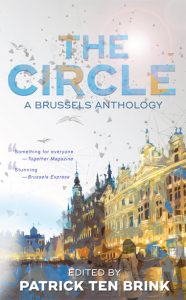 ‘The Museum of Favorite Things’ was first published in The Circle in 2018. Mimi Kunz is a visual artist and poet living in Brussels with her young family. ‘Put the mind in the body’, a Buddhist monk once told her — advice which has shaped her life and work. She studied Painting and Graphics at the Staatliche Akademie Karlsruhe, Germany, where she received an Academy Award and a project scholarship. Her practice has been shaped by residencies in Europe and Vietnam, grown in collaborations with dancers, writers, textile, and walking artists, and been supported by the Goethe Institute Hanoi and the European Union. Her poetry has been published in The Pomegranate London, London Grip New Poetry, Porridge Magazine, nominated for a Pushcart and shortlisted for the Bridport Prize. Her first collection Mother Tongue, a book of poetry and painting about the first year with a baby and the body as our first language, was published in 2024 (The Kyoudai Press). More on mimikunz.com